HoogWegt: Labor ShortagesDrive Farm Automation
Hoogwegt Horizon November Article

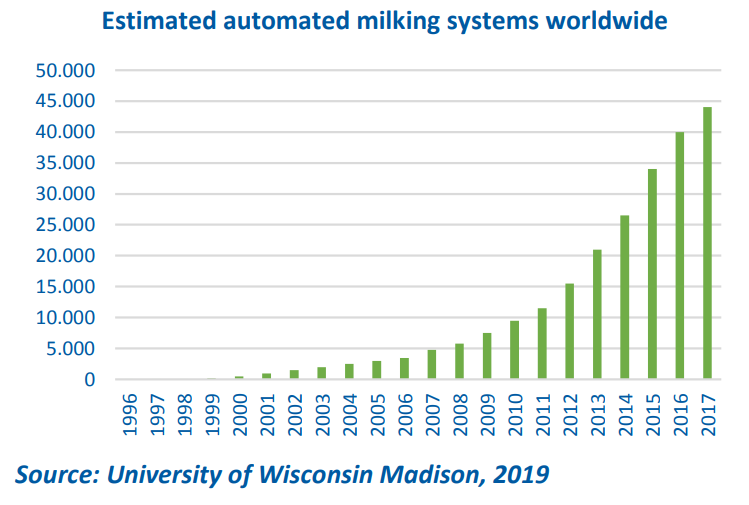
European dairies have been leaders in the adoption of automated milking systems, but producers in the United States and Oceania are also rapidly adopting these and other technologies. In 2018,only about 2% of U.S. dairy cows were being milked either by rotary or box-style robotic milkers, but that number could climb to 40% by 2025, according to some estimates.
These systems can be costly on the front end, but they also help farms lock in labor and labor costs at a time when ongoing shortages of agricultural workers persist and labor costs continue to increase. It takes only one person to operate a fully automated milking parlor with 60 individual robotic stalls. After a cow steps into its stall, the unit automatically attaches to the cow’s teat using a 3D camera, performs a prep procedure, milks the cow, and conducts a post dip. Producers can then receive data on their phones as milking progresses
Automated Milkers Boost Bottom Line
Recent studies show that as long as automated milking systems are well matched to the size of the dairy herd, milk yield can climb an estimated 12% when an operation is able to increase the number of daily milkings. Automated milking systems can decrease labor needs by as much as 18%, while improving animal welfare by allowing cows to choose when to be milked. These systems can also greatly improve a producer’s lifestyle.
The initial cost of investment as well as ongoing maintenance costs for automated milking systems have declined in recent years. In addition, as a growing number of producers invest in fully automated milking parlors, the number of local suppliers increases, making it both more cost-effective and easier for dairies to maintain and repair this equipment. According to a recent study, even a relatively small decline in the cost of equipment, an increase in the life of the equipment, or a large jump in the value of labor can greatly increase the economic return of an automated milking system compared to traditional systems.
These systems and other technologies provide improved and precise monitoring of individual cow performance, allowing producers to make cow-by-cow decisions, greatly improving efficiency and profit. This ability to automatically monitor individual cow performance becomes even more critical for small operations, where per-cow output has a major influence on an operation’s bottom line compared to larger dairies that enjoy economies of scale.
 One of the newest innovations in automated feeding systems is the delivery of precise rations on demand. This round-the-clock system delivers feed based on when and how much a cow needs to eat, resulting in reduced shrink, superior accuracy, operating cost efficiencies, and improvement in rumen health. Leg bracelets that monitor animal health and well-being through measuring how much a cow sleeps, eats, and moves can alert producers when a cow is starting to get sick, even before the animal shows symptoms
Over the next five years, producers who successfully adopt these and other technologies could see large competitive advantages over those who are slower to adjust to a changing industry. Farms that are already profitable, regardless of size or economies of scale, will be most likely to adopt the newest, labor-saving technologies. Those who either cannot afford the investment or who shun technology could find it increasingly difficult to compete.
World Comment
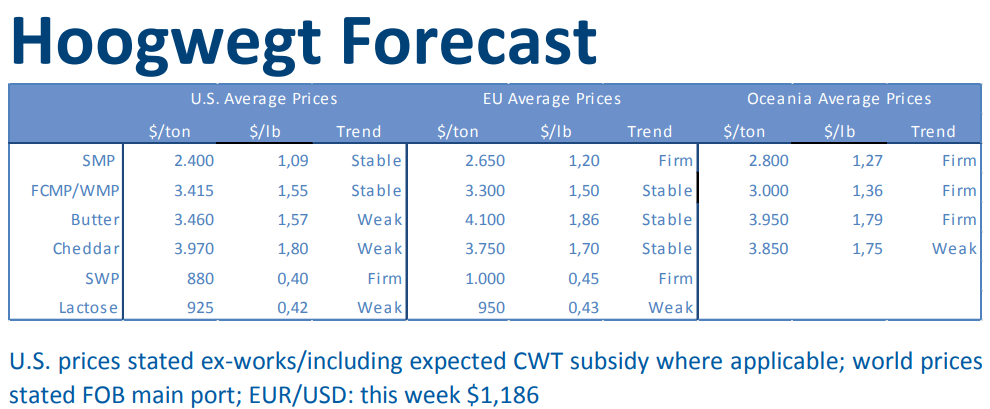
Since we are in the midst of the second Covid-19 wave in most of the Western-world, let’s start with the demand side. In the EU retail demand grew by about 6% in Germany and France, the UK experienced a retail demand growth of over 10% in June, July, and August. Because of this strong retail demand total dairy consumption in the EU is expected to end in 2020 with 0,6% growth. Consumption patterns are slightly different in the US, where dairy consumption is more depending on the out-of-home sector. Hence, the year is forecasted to end with very small decrease of total consumption. In China however, imports are not expected to grow in 2020 after 5 years of strong growth.
Production in NZ will most likely not grow vs the previous season. Firstly, because of the exceptional strong season last year. Secondly because of some drought early in this year’s season. Main production countries in the EU are likely to end the year without any growth. Also because prices are not yet favorably enough for farmers to invest and expand their farms. US will likely end this year with positive growth figures, mainly driven by favorable cheddar prices. Latin America is expected to have a larger surplus than the previous year. Due to lack of demand and strong production figures.
Companies Expand Technology in Several Areas
New technologies throughout the dairy supply chain have been increasing the competitiveness of companies that can provide the healthiest, safest, and most affordable products to consumers. From processing to traceability and packaging to waste-reduction technologies, dairy processors have needed to retool their plants or build new ones to stay abreast of technology innovations to increase their competitiveness.
The global dairy processing equipment market, estimated at $9.2billion (U.S.) in 2020, is projected to grow to $12 billion by 2025,according to Markets and Markets. Improvements in this sector will be critical as the world’s dairy processors strive to meet the world’s rising consumption needs.
Automated processing systems help reduce waste and improve profit. Using robots can minimize safety issues by limiting human to-human interactions and contact with food. Robots can sanitize plants, minimize contamination, and help trace products in the event of a recall. They can also work where humans cannot, including in freezing temperatures and low-oxygen environments.
A growing share of consumers today look for products that reflect their personal values and support companies that are transparent about how they produce food and source raw ingredients. According to Forbes, “The brands consumers eat,
drink and wear have become an expression of who they aspire to be.” These and other consumers can use smartphones apps to swipe a product’s QR code to learn almost everything they want to know about a product’s ingredients and nutritional value as well as the company’s environmental and animal welfare policies.
While adopting new technologies requires substantial investment, not staying current can greatly reduce a company’s success and prove more costly in the long run.