
HoogWegt: Global Milk Supply Growth Slows in Key Regions
HoogWegt Horizon on October 2020
Milk production growth in developed dairy regions has been difficult to achieve in recent years. From January 1, 2015, through December 31, 2019, aggregate annual milk collections from the top 12 dairy exporters grew just 0.8%, and in 2019, year over year output was flat.
In early 2015, the five year outlook called for greater expansion. From 2005 through 2014, the United States grew milk output by almost 2% per year, and in 2014, the European Union was getting ready to unshackle dairy producers from 30 years of production quotas. New Zealand’s output was also on the rise, following a huge expansion in Chinese demand for imported milk powders due to China’s melamine scandal. Between 2009 and 2014, New Zealand milk production grew more than 5% per year.
Gains Slow from a Combination of Issues
A combination of sustainability demands, climate change, and volatile dairy markets has curtailed growth since 2014. Milk expansion in the European Union and the United States has slowed, while New Zealand output has been flat since 2014, and production in both Argentina and Australia has contracted by more than 2% per year. Environmental restrictions have been strongest in New Zealand, Western Europe, Australia, and many parts of the United States, limiting herd numbers, adding to costs of milk production, and increasing the capital cost of new farms and expansions.
Production systems across major milk producing regions are diverse, as demonstrated by average per cow milk output and recent improvements in yield, which vary widely. From 1995 through 2014, much of New Zealand’s gains occurred through increased stocking rates and pasture productivity, but the gains have since stalled. In the European Union, per cow yields improved after quotas were removed as producers right sized their operations. U.S. per cow milk yields have grown at a slower pace, but the average fat content of milk has increased to keep pace with rising consumer demand for butterfat.
These pressures, coupled with a lack of generational succession,have driven consolidation. The exit of many small farms has, in turn, boosted average per farm output. Consolidation has been most evident in the United States, where the largest drop in farm numbers in 15 years occurred last year.
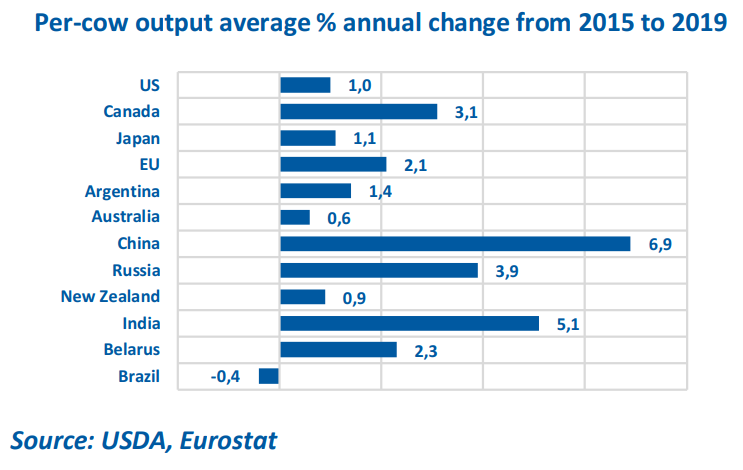
While key developing dairy regions typically have lower per cow yields, the potential for expansion of milk production is massive. These regions have a wide diversity of farm types and their future development journeys will be vastly different. In China, Brazil,and Russia, for instance, an increasing share of milk is being collected from large scale, intensive farms, many developed in partnership with processor investment. However, a large portion of the milk supply in these countries still comes from small,mixed livestock farms and village or family holdings.
In India, annual year over year milk production grew 5% over the past decade to reach 191 billion kilograms in 2019, but only about 40% of that milk is shipped to processors in the “organized sector,” according to India’s government. While the volume entering the organized sector is rapidly expanding, it is not expected to keep pace with local demand as living standards increase and consumer tastes evolve.
China’s dairy sector continues to be in a rebuilding phase. In 2019, milk output grew 4% to an estimated 32 billion kilograms, a 10% decline from 2008. China’s dairy industry is shifting toward large scale facilities, more than 1,000 cows, to improve milk security and quality. The share of milk being produced by these farms increased from 20% of the total in 2008 to 60% in 2018.
World Comment
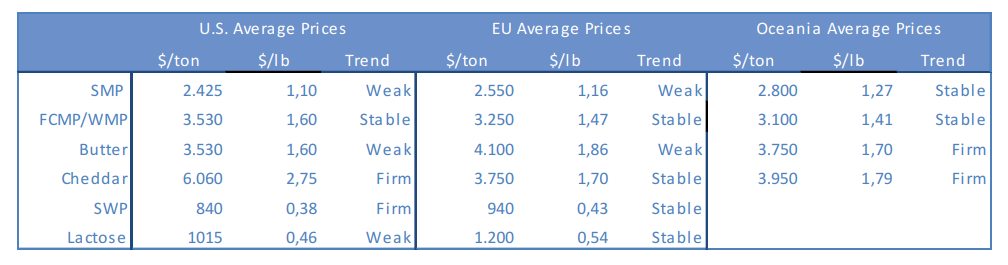
New Zealand is expected to have a slightly lower milk production than initially assumed. August was still a strong month showing 5,3%increase vs last year. September and Q4 was already expected to see lower growth number, simply because it’s hard to grow in these seasonal strong months. But with current pasture 6% below historical average, these growth figures might be more impacted. In Latin America AL Nina seems to have a positive impact on the growth figures. Current expectation is that the first half of the season will see growth rates of approximate 8%. Drought and high feed costs are likely to have its negative impact on the second half of the season. In the US milk production remains healthy. The government support is holding farmer’s profit at an acceptable level. As a result, farmers haven’t got an incentive to step on the brakes at the moment. The EU is continues in the same pace as in the previous months. Aggregate growth is expected to end up just below the 2%. On the demand side it is not so likely that China can keep up the strong imports as we’ve seen in H1. But Mexico is likely to support SMP and NFDM with stronger imports compared to the disappointing first half of 2020.
Milk Production Growth Picks Up in 2020
Milk output from the top 12 dairy exporters grew 1.8% in the first seven months of 2020, helped by the mild European winter,better seasonal conditions in Argentina and Australia, and favorable global feed grain prices. In China, the milk supply grew by a staggering 8% in the first half of 2020, according to the Ministry of Agriculture. However, in the last five months of this year, global milk output growth is expected to slow somewhat.
One of the many challenges of managing food supply chains during the corona virus pandemic has been reduced capacity at slaughterhouses due to a high incidence of infections in these plants’ work forces. A back up of animals at plants has constrained culling. While this ongoing situation could temporarily keep more cows milking, it will also limit average gains in productivity by keeping low performing cows in the herd.
Weather is expected to have a mixed impact on milk output in the coming year. A La Niña system could present challenges to summer output in New Zealand and Argentina, and also negatively impact feed crops in the southwestern United States.
Longer term, advancing technologies in automation and data management will be key to yield improvements. Development of genetically modified (GM) pastures and feed will offer significant upside in yields, but their use will be constrained by consumer distrust of GM products.Looking even further into the future, recently announced environmental policy initiatives could raise barriers to growth.
For instance, New Zealand has proposed a National Policy of Freshwater Management that will align regional regulations and increase scrutiny of dairy farming. Meanwhile, the European Union announced its proposed Green Deal, while setting a goal to have 25% of its agricultural land under organic farming by 2030.