
Oceania Dairy Market Overview Mid January 2020
Report 3 – Released on January 16, 2020
AUSTRALIA:
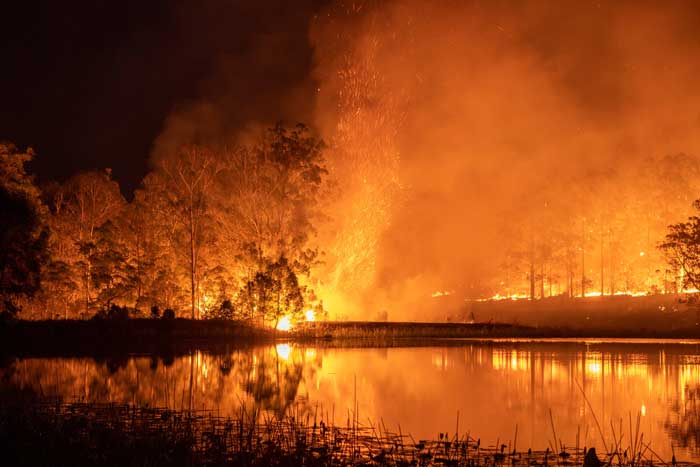
When fires started burning in Australia last fall, few dairy producers or officials expected they would still be burning in January. The sickening and heartbreaking work of burying burned cows, and euthanizing badly injured cows, continues on a number of Australian dairy farms. An agricultural banker estimates that as many as 70,000 dairy cows were killed so as a result of the fires that still burn. Some dairy officials estimate that a couple of million liters of milk have been lost so far.
The concept of cow parking is increasingly being considered and used. Cows in areas threatened by fire in some cases, can be moved to safer areas. However, the cows continue to need to be fed and milked. The milk needs to go somewhere. This can limit options for whereto move cows to where there is food, water, and the ability to milk them. Some milk is necessarily dumped because the new temporary locations lack trucking capacity to move milk from farms, or access to available processing capacity for the increased milk supplies.
Strong hay demand as 2019 ended in Australia has become even stronger. Continuing drought in many areas, coupled with fires burning since October, contribute to this situation. Significant amounts of hay are moving across large parts of Australia. Many areas have inadequate capacity to move hay quickly to buyers, due to the amount of hay being moved.
Fire damage to pastures and hay supplies is extensive in New South Wales, Queensland, and east Gippsland. Some farms which usually sell extra hay are holding back due to uncertainty of whether they may end up needing it for home farm purposes. Little hay was made this season in Northern Australia. In Southern Australia, hay from last season is in short supply and there is substantial frost damage to hay grown this season. Hay yields were low in Western Australia.
NEW ZEALAND:
November 2019 New Zealand milk production reported by DCANZ was 3,003 million MT, up 0.3 percent from November 2018 milk production, 2,995 million MT. November 2019 milk solids,249,135 million kg, are up 0.4 percent from November 2018, 248,156 million kg.
This results in current season milk production through November being 0.4 percent lower than this point last season, according to Eucolait. However, milk solids production this season through November is up 0.5.
Weather has been somewhat dry, a factor cited as contributing to weaker milk production.Winter in New Zealand was dry, with less rain than normal. That carried into Summer, now causing increasing anxiety. For example, supplementary crops typically grown by a number of dairy producers have brought disappointing yields. That could lead to some producers having to buy imported feed at current higher spot prices, adversely affecting margins. There is still time for rain to help, but for now, uncertainty prevails.
  Information for the period January 6 - 17, 2020, issued biweekly

     Published by:
     Dairy Market News - Madison, WI
     Eric Graf, 608.422.8590
     Email: Eric.Graf@usda.gov

     Additional Dairy Market News Information:
     Dairy Market News (DMN) by Phone: (608)422-8602
     DMN Website: https://www.ams.usda.gov/market-news/dairy
     DMN MARS (My Market News): https://mymarketnews.ams.usda.gov