
Correlation Between Dairy and Crude Declining
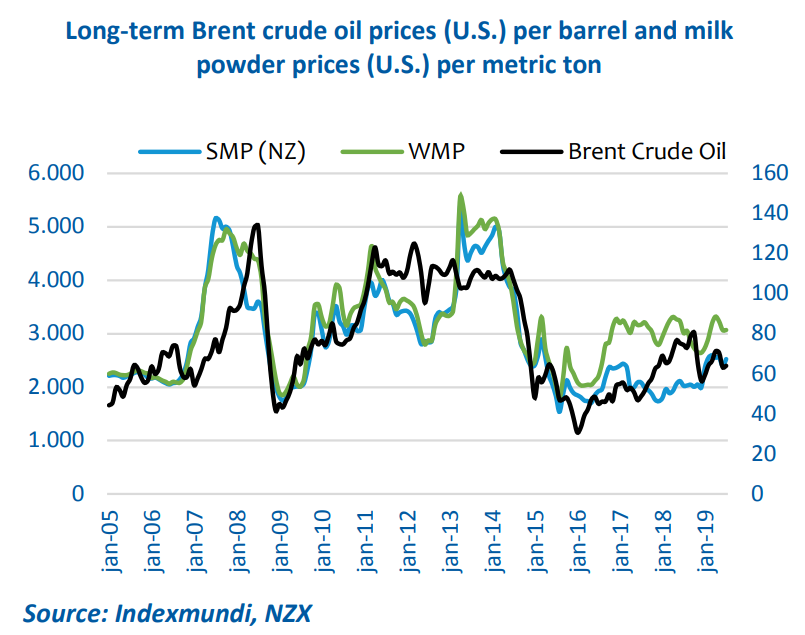
Crude oil prices continue to have a significant bearing on the world economy and consequently on dairy supply and demand, but the relationship between the two has been changing. For a long time, crude oil prices and the price of several dairy products, including skim milk powder (SMP) and whole milk powder (WMP), were closely correlated. However, the relationship between crude oil prices and commodity milk powder prices has been far less evident since 2015.
The crash in crude oil prices that occurred between mid-2014 and early 2016 as well as the subsequent slow price recovery have had a profound impact on the economies of some of the world’s key dairy-importing markets. According to data from the Global Trade Tracker, WMP exports to the oil-rich dairy markets of the Middle East and North Africa (MENA) region plunged between 2015 and 2018. Imports of butterfat products in the MENA region also fell, down 18% over the same period as butter prices spiked. During that time, Venezuela also purchased less WMP, but its imports of SMP increased.
Oil Glut Creates Uncertainty
Dairy exporters remain concerned over the uncertainty facing crude oil markets and the global economy. Despite ongoing geopolitical tensions in the Middle East and efforts by the Organization of the Petroleum Exporting Countries (OPEC) to curb overproduction of crude oil, prices have staged a weak, erratic recovery. Moreover, the expansion of U.S. shale oil production and an effort in developed economies to reduce dependency on fossil fuels to stem the advance of climate change have added to the global glut in crude oil supplies and a weak price recovery.
When crude oil prices remain within an affordable range, the global economy tends to benefit as do consumers in both oil-rich and oil-importing economies. A healthy global economy helps boost dairy demand in both the developed and developing world, but a weak crude oil market tends to negatively impact traditional crude oil exporters. Whether dairy-importing countries can sustain purchases during a downturn in crude oil prices depends on each economy’s dependence on oil revenues,its break-even oil price, fiscal reserves, and how willing the government is to subsidize its citizens’ food expenditures.
At the same time, sustained periods of high oil prices adversely impact consumers and businesses in developed economies such as the United States, Europe, Canada, and Oceania. Higher gasoline prices tend to reduce discretionary spending on dining out, which typically puts downward pressure on butter and cheese demand. Periods of high crude oil and gasoline prices can also increase the price of other consumer goods due to growing transportation and manufacturing costs, further cutting into discretionary spending.
However, every year millions of hybrid and electric vehicles enter the global vehicle fleet. Last year in the United States alone, demand for all-electric cars soared 81% to more than 370,000 vehicles, and the global electric car fleet exceeded 5.1 million, up 2 million from 2017, according to the U.S. Energy Information Administration. As consumers become more aware of the benefits of fuel-efficient vehicles, demand for gasoline, which has stagnated in recent years, could further work to decouple crude oil prices and dairy markets.
World Comment
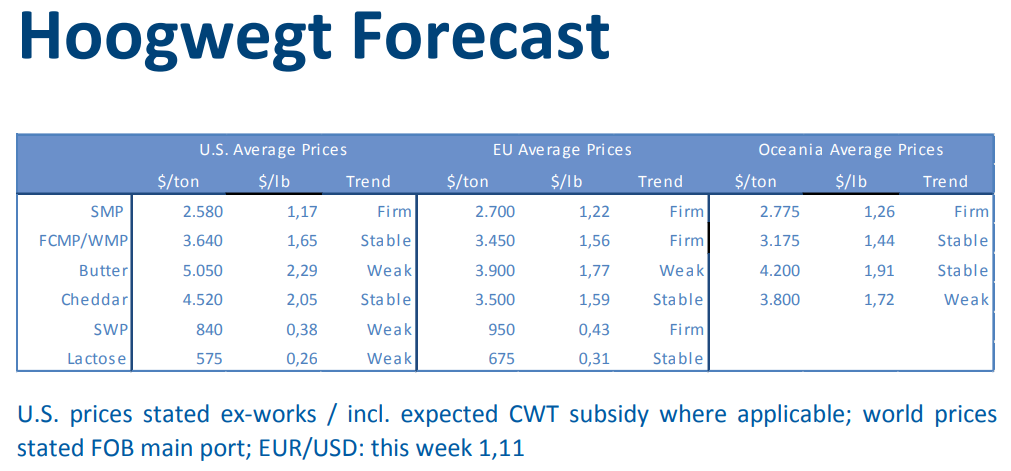
Global milk production still not very strong; all major milk producing area’s are more or less on par with last years levels. And short term no significant increase can be expected. Europe is entering their seasonal low in the milk season and in New Zealand the sub-optimal weather on the South Island is preventing an upside surprise. Butterfat continues to be under pressure, although the fall in prices seems to be slowing down. WMP prices are stable; South-American product finds its way into Algeria without too much trouble and so far China is absorbing available volumes from New Zealand. In Europe little WMP is produced at the moment. SMP market has been most active product in recent weeks and showing solid price increases. European Government Intervention Stocks are steadily disappearing from the market and spot availability is very tight, so no short-term correction can be expected. Majority of Q1 SMP business still needs to be concluded, but it is uncertain if market can afford todays prices which are higher than we have seen in the last 3-4 years. SWP market in Europe has tightened, but as Asian demand is not strong yet it might take some time before prices can really start moving up. All in all quite some mixed signals in the market and uncertainty about what prices will be in 2020.
Oil Glut to Collide with Weaker Global Economy
Heading into 2020, the U.S. Energy Information Administration expects the global glut of crude oil to weigh on prices, as demand slows and supply grows. Expansion of oil production in the United States and by non-OPEC suppliers will likely offset production cuts from OPEC and Russia. While unexpected geopolitical supply disruptions could still create volatility in crude oil prices, a slowing of the global economy, which is widely expected in 2020, could reduce overall demand for crude oil and dairy products in some regions.
Major trade disputes—primarily the sustained impasse between the United States and China—have already contributed to a slowing of global economic activity, which the World Trade Organization expects to worsen in 2020 if the trade disputes are not resolved. Earlier this month, the new head of the International Monetary Fund said that the U.S.-China trade war could mean the loss of around $700 billion for the global economy by next year. Further uncertainties, such as Brexit, could slow economic activity in the United Kingdom as well as trade between England and other European countries.
Steady to lower crude oil prices coupled with reduced overall demand and constrained output from OPEC will continue to keep downward pressure on traditional oil-exporting economies. But global dairy demand next year will hinge on dairy product prices. After five years, the SMP surplus has finally cleared, and markets are once again operating on working inventories. The artificially low milk powder price made dairy more accessible in oil-rich countries despite a multi-year downturn in crude oil prices. Dairy prices are now rising as the market transitions to a period in which importers’ buying power could be limited. While this could be negative for dairy demand in 2020, lower oil prices could increase discretionary spending elsewhere, lifting consumption— confirming that the relationship between dairy and crude oil is complicated.