Dairy Alternatives Here for the Long Term
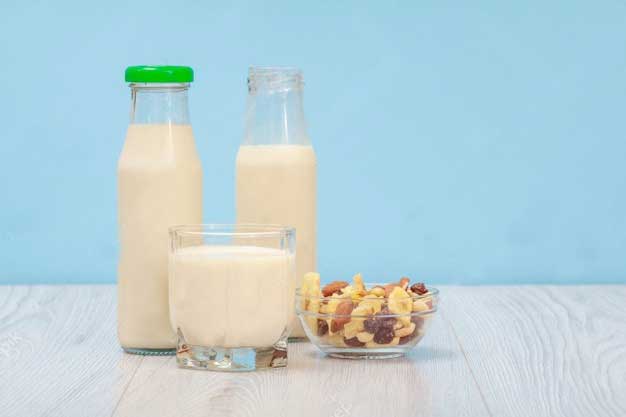
vDairy alternatives have been receiving lots of media attention and investment recently, in part, because a growing number of consumers have been trying them. These alternatives, for the most part, refer to plant-based products that mimic dairy in appearance, usage, and name but offer a different taste and nutritional profile. Plant-based dairy alternatives offer a source of protein from a growing array of plants. Oat beverages, in particular, are gaining popularity and could soon rival almond and other nut-based dairy alternatives.
A new category of lab-based alternatives purportedly mimics dairy products more closely. These new technologies replicate milk by using yeast to produce dairy proteins and enzymes. Startup Perfect Day, which is making synthetic dairy ingredients, has raised $61 million (U.S.) and counts grain-trading giant ADM as a key investor. While these synthetic alternatives have yet to be commercialized, some consumers have been willing to try labbased meat products. The expansion of dairy alternatives is part of a wider trend of consumer adoption of substitutes for all animal-based products. Consumers who perceive plant-based products as healthier and more environmentally sustainable and/or who have concerns over animal welfare, along with marketers and activists are driving this trend.
Policy makers are also increasingly reflecting and amplifying the environmental concerns. Canada’s updated national dietary guidelines, for instance, no longer mention meat and dairy, but instead recommend plant proteins that take sustainability into account. While the credibility of Lancet has been questioned by some, the EAT-Lancet Commission report released earlier this year recommends a “planetary diet” rich in plant-based protein sources. Consumers appear to be listening.
What Consumers Think
However, misinformation and confusion are rampant, and many consumers believe alternative dairy products contain milk, according to the International Food Information Council Foundation. Nearly half, 46%, of U.S. consumers think plantbased proteins are healthier than animal sources. Furthermore 76% say plant-based foods are healthy, according to Mintel.
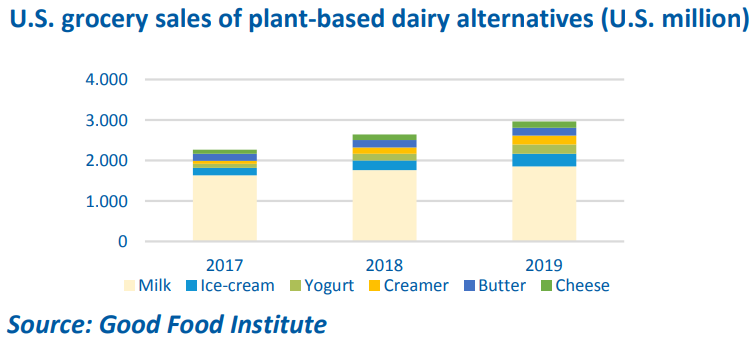
More than half of U.S. consumers also think plant-based foods are better for the environment than their animal-based counterparts. According to Innova Market Insights data, global food and beverage launches positioned as vegan between 2013 and 2017 grew at an average annual rate of 45%, increasing market penetration in Europe from 1.5% to 7% over the period. In the United States, the Good Food Institute reports that plantbased beverage sales reached $1.9 billion (U.S.) in the 12 months prior to April 2019, up 13.5% in just two years. Although milk is still used in 96% of U.S. households, an estimated 37% of households also purchase plant-based beverages. This lays the foundation for increased purchases of other plant-based dairy substitutes, which are valued at $1.2 billion (U.S.) and have grown by 73% in the two years prior to April 2019. Alternative yogurts, creamers, and ice-creams are the fastest-growing segments. For now, consumers seems less willing to consider cheese alternatives.
Vegan diets are still well in the minority, but plant-based dairy alternatives are finding a ready market, particularly in developed countries where a “flexitarian” diet is becoming more mainstream. This diet strives to reduce, rather than eliminate, consumption of animal-based products. DSM Food Specialties found that 60% of those reducing dairy consumption expect to continue doing so over the next three years. Looking ahead, improved taste and functionality will be key to making alternative dairy products appealing to younger consumers and others who want to experience exotic products as part of what they perceive to be a healthier and more ethical approach to eating.
World Comment
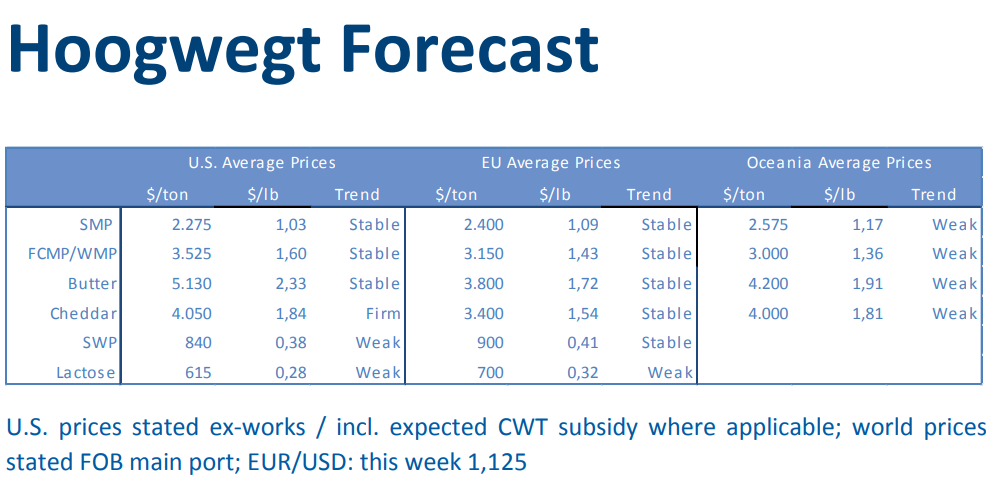
With many people enjoying their summer vacation, the dairy market seems to have cooled down. Both In Europe as in USA we see stable prices for most dairy commodities. In NZ the last GDt showed price decreases for all products. Milk production in the 11 main exporting countries shows a negative growth YTD (compared to an average growth of 1.4% in the last 5 years). However, demand for dairy commodities still has not been strong enough to push prices significantly up. In WMP we see that Chinese demand is not able to compensate decreased consumption in Algeria which is suffering from a government budget deficit and replacement by fat filled powder in Africa and Middle East. Butter market in Europe has stabilized at the lowest price in the last 3 years, but it is unsure whether there is still further downside left. Political tensions between the European Union and Indonesia (and maybe Malaysia as well) might cause significant swings in trade flows of SWP and SMP from EU to USA. Indonesia currently already buys SMP in USA and Oceania, but is much more dependent on EU for the SWP. In general market feels fairly balanced for most products and no major swings are expected, but as most products are thinly traded, relative small adjustments in supply or demand can have a strong effect.
Dairy Needs to Play to its Strengths
Given the convergence of consumer trends, innovation in marketing and processing, and environmental policy, plant-based dairy alternatives likely have staying power. Growth rates are expected to outpace those for dairy product consumption over the next five years at least. Rapid growth in these alternatives will further crowd the market space, creating a dilemma for dairy farms that want to expand. Dairy industry resistance to the rise of dairy alternatives has been largely focused on regulating the use of the terms milk, cheese, butter, ice cream, and yogurt to only those products produced with natural milk. Both the U.S. Food and Drug Administration and the EU Court of Justice have backed the proposition that milk used for drinking and manufacturing must come from an animal. While dairy alternatives are substitutes for use, they are not analogues for nutrition without significant fortification, and they vary significantly in nutritional value.
The perception that dairy alternatives are inherently better for you and the environment has gone mostly unchallenged. This is where the dairy industry can play to its strengths in taste, nutrition, and minimal processing, all areas where dairy holds a clear advantage over plant-based competitors. Natural products with no artificial ingredients or preservatives are important to millennial consumers and others seeking healthy products that have a minimal impact on the environment. Dairy must work harder to give these consumers and others permission to continue to enjoy dairy products. This will keep pressure on the dairy sector to cut greenhouse gases and other emissions, while demonstrating high animal welfare standards. To reach selective food buyers, the dairy industry needs to tell a holistic story, one that incorporates environmental stewardship and animal welfare.