Hoogwegt Horizon: Russia Seeks Self Sufficiency in the Cold
HoogWegt Horizon June 2020 Report
The Russian dairy industry has been partially isolated from the world dairy market since it placed an embargo on imports of cheese and butter from the European Union, United States, and others in August 2014. Since then, the country’s long term plan has been to attract investment to build local milk production to achieve President Vladimir Putin’s goal of achieving self sufficiency in dairy product manufacturing. During this period,the country has also taken on the challenges of reducing the prevalence of counterfeit dairy products while increasing exports.At least some of these goals have been achieved.Prior to the 2014 embargo, Russia imported up to 25% of the raw milk it needed to produce enough cheese, butter, and other dairy products to feed its people. In 2019, Russia was only about 5 billion kilograms (11 billion pounds), or 14%, of raw milk short of being self sufficient in dairy product production based on 2019 imports of cheese, butter, milk powders, and fluid milk.
Investments Drive Growth
Milk production in Russia grew just 2.7% since 2014 to exceed 31 billion kilograms (68 billion pounds) in 2019, with much of that growth occurring last year. Considerable efforts have been made to lift milk production through attracting investment in farms,increasing cow productivity, improving skills, and importing high performing animals from Europe. According to the National Dairy Producers Union, the industry has attracted $3.1 billion (U.S.) in total investment since 2014, with German farming group Ekosem Agrar a leading example of the expansion. Local and foreign companies have made corresponding investments in cheese and fluid milk plants.
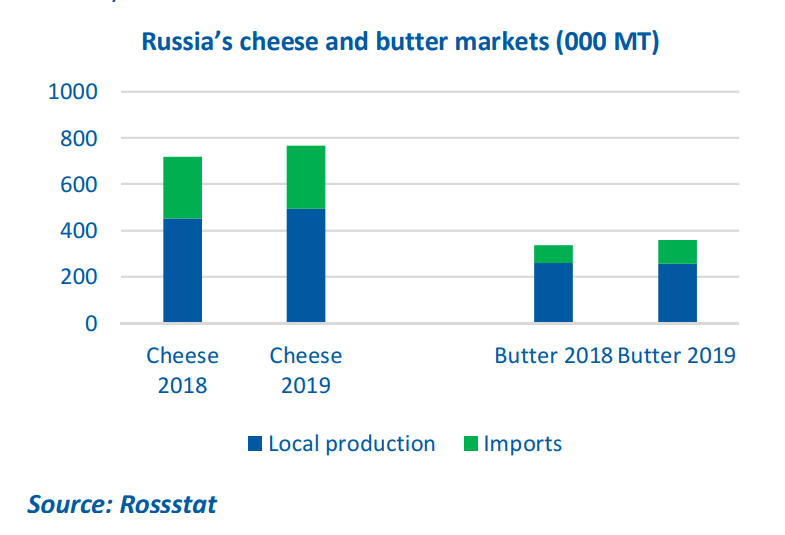
Cheese production grew 10% in 2019, according to Rossstat, but Russia still imported 35% of its market requirements. The country remains heavily reliant on cheese imports from Belarus, with small volumes coming from other nearby suppliers. Meanwhile,Russia imported 30% of its butter needs in 2019, and Belarus had more than half of that trade, although New Zealand and Uruguay have also increased share.
effects of economic sanctions and low oil prices. The country has also seen an increase in consumer spending and affordability of highquality dairy products. In an effort to boost percapita consumption, which fell 6% between 2011 and 2017, the government has been trying to improve the quality of dairy products offered in the local market, according to the AgMinistry.
Dairy consumption in Russia slowed as purchasing power declined, but lack of consumer confidence in the integrity of milk and other dairy products sold in grocery stores has also played a role in the decline. In 2016, Russia’s veterinary regulator Rossel hoznadzor claimed that 30% of all dairy products sold in the country were cheap fakes that used a range of substitutes reminiscent of the melamine scandal in China. To counter this,the government has been working to improve product certification to ensure authenticity and has introduced stricter traceability in the supply chain.
From time to time, there has been talk of lifting the 2014 food embargo, but it seems unlikely that Russian leadership will alter course. Instead, Russia will continue to build its agriculture sector. However, last year, the Russian dairy industry joined the International Dairy Federation, providing a glimmer of hope that eventually Russia could lift its ban.
World Comment
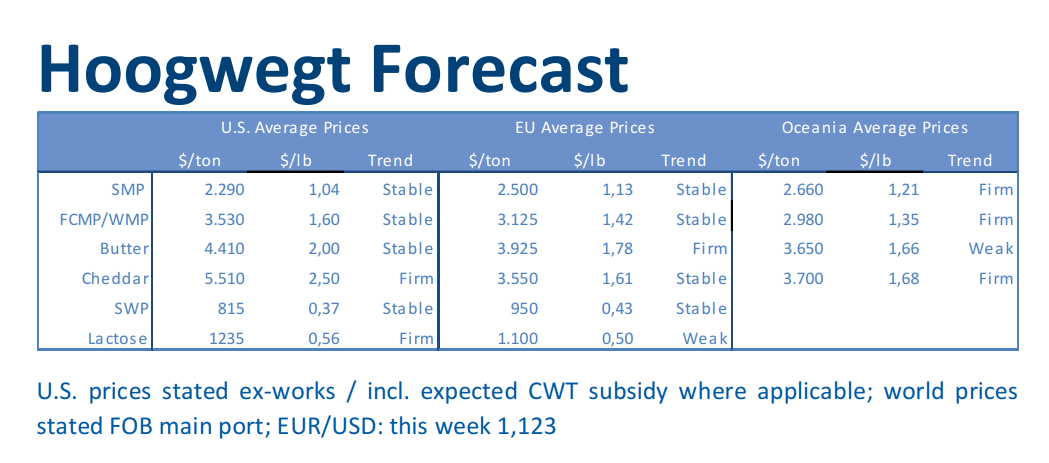
Global milk production is expected to grow by about 1% this year. Supply growth is relatively stable around the world, with the exception of the EU. The drought in the EU does seem to have influence on the milk production, resulting in negative growth numbers for France and the UK in Q2 this year. Germany, France, and the Netherlands experienced increasing rainfall in the past weeks, and more rainfall is expected in the coming week. At least for the short term, the immediate danger of a severe drought has been diminished.US production growth is stable, with no big swings up or downward. However, the demand side is experiencing swings due to the governmental support program. Although the program will cannibalize part of the dairy demand, it does support current milk prices in the US. Approximate 1% global milk production growth is disappointing given the weak production figures already in 2019, but it still results in a surplus given the weak demand during the first six months of 2020 and the expected weakness of demand in the remainder of the year.
COVID Interrupts Russian Growth
After a slow, steady recovery in the Russian economy over the past decade, the country must now deal with the impacts from the double crises of the corona virus pandemic and the rapid decline in oil revenues. While these shocks have disrupted the country’s improving financial stability, Russia today is in better shape financially than it was at the start of the last decade to manage the damage.
COVID19 came as a cruel blow just when Russia’s dairy sector was rapidly increasing milk output. Spurred by strong milk prices,milk production expanded by 4.3% in the four months leading up to April 2020, compared to the same period a year earlier. The expanding milk supply helped to push cheese output 13% higher during that same period, which was still not fast enough to keep up with surging local demand.
Russia was slow to follow other major regions in implementing stay at home restrictions to limit the spread of COVID19. But subsequent restrictions on citizen movements and activities,similar to those implemented elsewhere, will continue to damage the Russian economy and slow dairy consumption, especially with the closure of food service outlets. A switch away from food service toward stronger grocery store demand has also been apparent, and by early reports, increased retail purchases have limited the overall loss in dairy demand.
Restrictions on movements and activity have quickly led to the building of dairy stocks as food service demand plunged,pressuring both raw milk and wholesale product prices lower.
The near term creates great uncertainty for the food sector,including dairy. Many questions regarding the timing for when regional dairy markets will return to balance remain unanswered,including how long it takes to reduce new COVID19 infections,how much disruption occurs to dairy production, how quickly movement restrictions are eased, and how long it takes for consumer spending to recover.