Demand for Whey
Products Looks Bright
Products Looks Bright

Demand for whey proteins has skyrocketed over the past two decades, driving the value of these products higher. The whey stream, a byproduct of cheese making, was once worth little and used primarily as animal feed. But over the past couple of decades, diversification of whey products grew along with demand for these products. Today, major whey ingredients include sweet whey powder (SWP), demineralized whey powder, which is overwhelmingly produced by EU member states, whey protein concentrate (WPC) with various protein concentrations, whey protein isolate (WPI), and whey protein hydrolysate (WPH). Each of these products has its own growing market. Given today’s heightened global focus on health, nutrition, convenience, and protein, demand for whey products will continue to grow, particularly in the developing world where migration from rural areas to cities continues. As people in the developing world move into desk jobs as opposed to farm labor, they become more dependent on gyms for exercise and wheybased products for muscle recovery, as well as healthy snack products and convenience foods for nutrition. These trends will continue to boost demand for sports and lifestyle nutrition products, which primarily use WPC80 and WPI.
Driven by Sports and Lifestyle
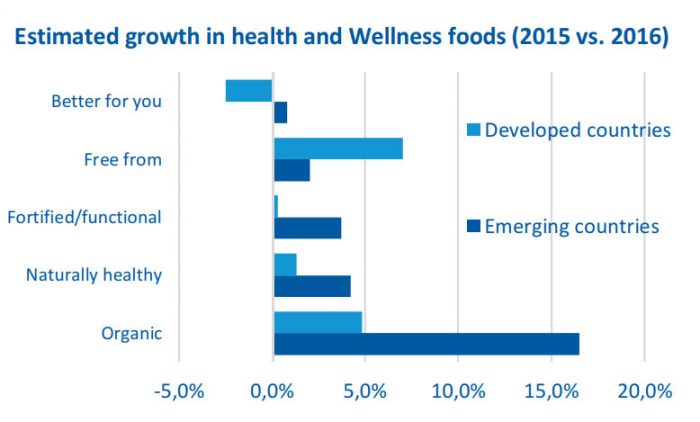
The global protein supplement market of which sports and lifestyle nutrition is a key part is projected to grow to $21.5 billion (U.S.) by 2025, up from $14 billion in 2018. The whey protein segment of this market accounts for nearly 57% of the total, according to Grandview Research. Moreover, the global health club (gym) industry, which generates $84 billion a year, is also growing, according to the IHRSA 2015 Global Report. While some health club markets, such as Australia and New Zealand are considered mature, with penetration rates of 14.8% and 11.4%, respectively, others such as China and India have penetration rates of just 0.4% and 0.13%, respectively. The upside potential in Asia for sports nutrition is huge. Infant formula is another major market for whey proteins, specifically WPC3580 and demineralized whey powder. Demand for wheybased infant formulas is particularly strong from China. Other major markets for whey proteins include recombined milk products, chocolate, and bakery goods. SWP and WPC35 are used to make affordable recombined milk product replacements, particularly for markets in Southeast Asia and Africa. In Europe, some chocolatiers are using SWP as a lowercost alternative to skim milk powder (SMP), particularly for milk chocolates and chocolate spreads. Bakers also have an opportunity to substitute SWP for SMP based on competing values.
Over the past several years, the gap between whey protein values and milk proteins has narrowed due to several trends. At times, WPC35 has even carried a premium to SMP, which has spurred some manufacturers of meal replacement products to switch from WPC35 to milk proteins. Moreover, for some product lines, such as recombined milk products and lifestyle nutrition products, processors can readily substitute milk proteins for whey proteins. Buyers of dairy proteins can take advantage of these opportunities and shift formulations to reflect changing values. This ability to reformulate tends to either pull or weigh on each of the protein classes. While temporary setbacks and shifts can occur, consumers’ predilection to choose highprotein snacks and grab wheybased sports nutrition and lifestyle products after a workout have longterm staying power—and that means demand for whey proteins will continue to increase.
World Comment
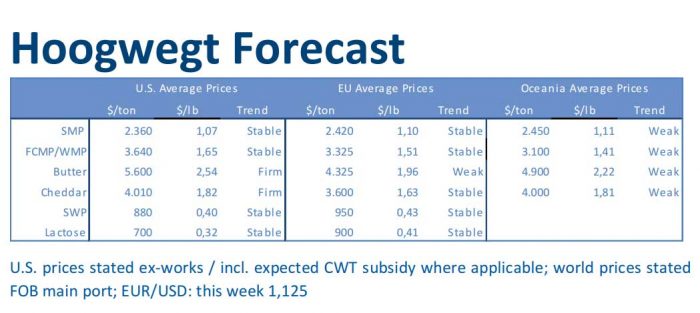
Global milk production still lingers around 0% yoy. And although milk prices are profitable in most regions it is not expected that in the second half of this year milk production will grow much above 1%. This is below the consumption growth we have seen in recent history. However, buyers do not seem convinced this will result in much higher prices and are in no rush to cover forward. Maybe due to various holidays, market for almost all commodity milk products have been very calm in recent weeks. This has resulted in stabilizing prices in the Northern Hemisphere after a bullish period. In Oceania prices have moved even down in the last GDT, bringing most prices roughly back on par with EU and USA. Butter market has been the most volatile recently, with big fluctuations in price as well as big differences between origins. European butter is competitive on the world market, more or less on par with Indian and EastEuropean origins and trading at the lowest level in almost 2 years. The coming month will play a determining role in how prices will develop for the rest of the year. Because many buyers still need to cover a decent portion of their Q3 needs and a lot uncertainty around the weather will have disappeared. Although fundamentally there seems to be room for increasing prices, a less than expected demand from the 2 main dairy importers in the world, Algeria and China, combined with a better than expected milk production could still result in easing prices.
Supply Development to Determine Market Stability Major developments affecting cheese prices and returns to cheese processors, primarily in Europe and the United States, will be key to assessing the supply of whey proteins in the future. Moreover, cheese output is expanding at 2% per year and whey protein demand has been growing at 67%. While processors will want to supply growing demand for whey, they will be reluctant to do so if it means compromising cheese returns. Thus, whey supplies will likely only expand if cheese demand dictates. More immediately, the gradual clearance of EU SMP stocks, from both government storage and private holdings, will be one of the key determinants driving the value of dairy proteins higher. Improving milk protein prices will, in turn, support rising prices for higherprotein whey products. Expectations for EU and U.S. milk production and demand from China will also play a critical role in the shortterm outlook for whey. We witness cheese capacity increase in both Europe and the United States; the main cheese producing regions. The complementary increase of liquid whey is resulting in additional WPC and WPI production while whey powder production is expected to stay at todays levels for the period 20192021. Demand for lowerprotein products has also grown, but supply has not. Through 2018, the value of SWP on a protein basis was in parity with higherprotein WPC and WPI products, eroding returns on these products. However, the recent plunge in SWP prices could help returns recover on higherprotein products provided demand expands. That said, with new supply primarily in WPC80 and WPI, prices for the lowerprotein products—SWP, WPC30, WPC35, and demineralized whey powder—could again close the gap on the higherprotein products as demand expands.