HoogWegt: Impacts of Stimulus Could be Long-lasting
HoogWegt Horizon June Report

Measures to control the spread of COVID-19 since February 2020along with stuttering attempts to reopen economies have beenhighly disruptive for global dairy markets. The profound and longlasting economic impacts of government policy responses couldalso have far-reaching impacts on dairy demand.
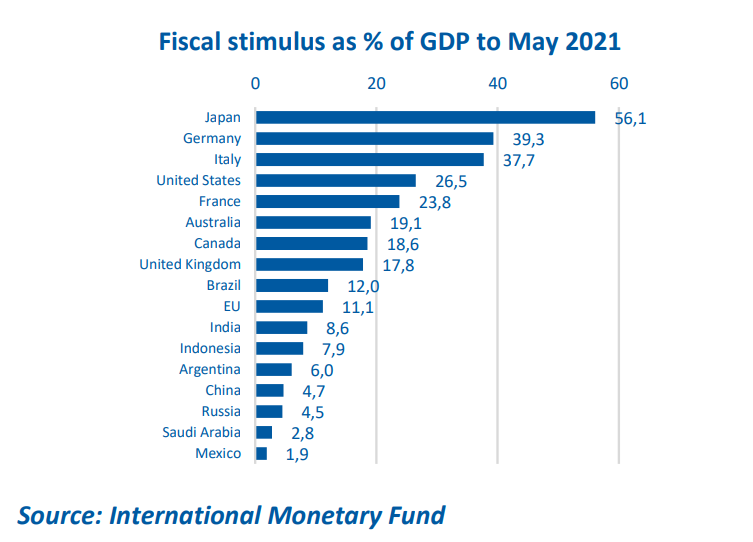
In the face of covid-19, the world needed a comprehensive andcoordinated cross-country policy response to the shutdown oflarge parts of many economies. This included swift deployment ofmedical resources, policy interventions to restore the normalfunctioning of financial markets, and other measures to supportfirms and households. Governments generally responded withfiscal stimulus measures to support households affected by lossesin employment and businesses facing revenue losses, but theyfailed to respond in a coordinated way. Their resulting policiesvaried widely in scale and timing and ranged from being highlysupportive and stimulative to austere. The chart at right depictsthe wide range of fiscal stimulus as a percentage of grossdomestic product (GDP).
Largest Stimulus Ever
The stimulus was funded by the largest printing of money everseen for a single event, including the global financial crisis. It isestimated that 40% of all money ever created occurred over thelast year. The flood of new money varied across major developedeconomies but was most dramatic in the United States. Theunevenness in these responses will shape the COVIDconsequences for the entire world for the next decade.
The rapid increase in liquidity drove interest rates to record lows,where they are expected to stay for several years. Increasedliquidity was greatest in countries that experienced a massivedecline in retail activity, employment, and mobility. Such a surgein liquidity can lead to waste and speculative investments as wellas a rapid escalation of asset prices, followed by a contraction (orbubble) if underlying activity doesn’t respond quickly.
Pushing such large amounts of stimulus to households to buffertheir finances not only increased asset prices, both property andequities, but also massively lifted household savings. Personalsavings rates in the United States in March, for example, werenearly four times as great as the long-term average.
Several factors have contributed to strong commodity priceinflation. The restructuring of work life, spending of stimuluspayments on household goods, and reopening of businesses haveall put a drain on certain resources. Some governments andsectors have responded to the fragility of supply chains bybuilding security stocks. This includes China’s increased purchasesof grains and oilseeds, which have coincided with weatherchallenges in production regions, as well as other resourcecommodities, all which have driven up prices. In addition toChina’s efforts, governments and companies worldwide havebeen trying to shorten supply chains and avoid undue exposureto just-in-time systems, further increasing near-term demand.
This inflationary surge is thought by many, including policymakers in central banks, to be transitory, because it is occurringwhen there is still considerable excess workforce and growth inwages has generally lagged upticks in economic activity. Yet thepotential increase in spending of accumulated savings once U.S.and European economies fully reopen could unleash a surge indemand for goods and services, soaking up capacity andsustaining inflation for much longer than currently expected.
World Comment
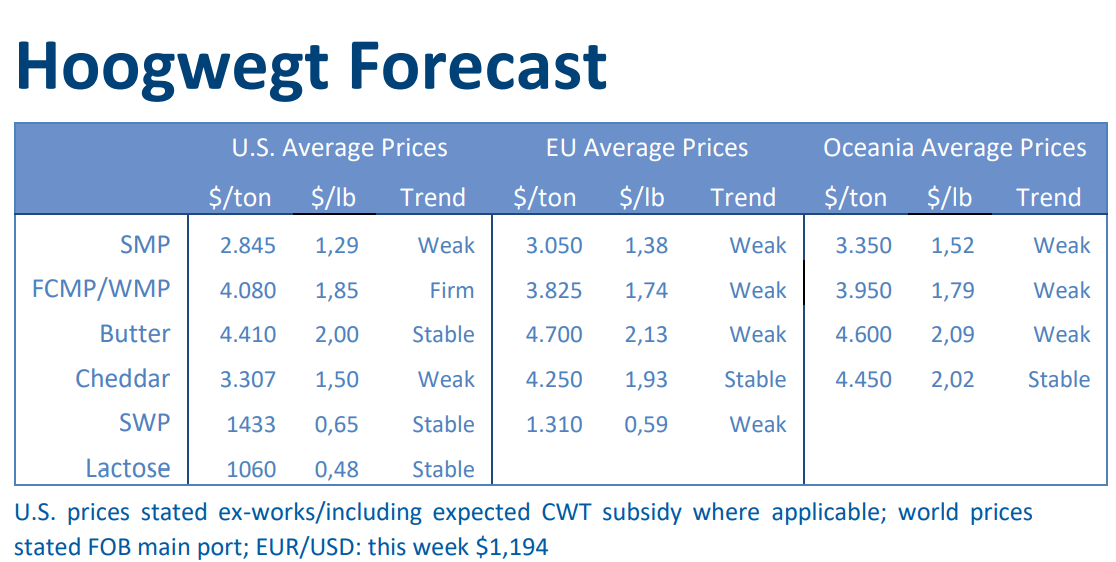
New Zealand is showing a relatively strong end of the season and is well placed for a goodstart of the new season. However, sustainability limitations is expected to have impact onthe growth in New Zealand, with nitrate reaching critical levels on the Southern Island. Thisis expected to limit growth to a maximum of 2% in the next season. The US is having anexceptionally strong year. But due to the high feed prices further growth towards the endof the year is not expected. These high feed prices also limits the production growth in the Northern hemisphere as a whole. But at the sametime these high feed prices are balanced out by the good sileage and corn quality in the EU. The growth figures in the EU in general seem tobe healthy with acceptable farm gate prices. For the moment we don’t see any big investments yet made by farmers to increase that output,but they simply try to max out production with their current herd. On the demand side China will be the most important factor again. We doexpect for H2 2021 similar import levels as H2 2020, leaving the whole of 2021 at 8% import growth vs 2020.
World Economies to Stage Uneven Recoveries
The International Monetary Fund (IMF) expects global economicgrowth in 2021 and 2022 to be better than earlier anticipated,due to additional stimulus measures and the rapid deployment ofvaccines in key countries. Many of the world’s developedeconomies are rebounding, but progress varies widely betweenthe United States, the European Union, and Japan.
Economic recovery in the medium term across the world willremain uneven and impact the future of dairy demand. Thesectors and regions scarred by extended mobility restrictions andlasting impacts on work practices and travel will recover slowly.Divergent recoveries will reflect differences in the speed andcoverage of inoculations, government support, and reliance ontourism and informal employment.
China’s economy has rebounded relatively quickly, and that hashelped neighboring regions. The less-developed regions of SubSaharan Africa, South Asia, and Latin America face increasedpoverty, which could take more than a decade to overcome. TheBrookings Institute estimates 120 million more people (a 20%increase) will fall into extreme poverty in 2020 compared to preCOVID levels, reversing strides already made to reduce poverty inthese regions. IMF estimates 80 million more people will beundernourished as a result and expects food insecurity to remaina massive challenge well into 2022.
Caloric intakes and consumption of protein are closely linked toimproving incomes, ethnic diversity, and living standards indeveloping dairy markets. Demand for dairy nutrition could sufferaffordability challenges in coming years, as social inequalitiesbecome more apparent. To sustain dairy market expansion inthese regions, processors and marketers will focus on innovationto address dietary benefits, portion costs, and viable productdelivery systems.