
HoogWegt: Risk ManagementAdoption Could Stem Volatility
HoogWegt Horizon on July 2020
For more than a decade, the global dairy industry has had access to risk management tools, including futures and options contracts for various products, and use of these products has continued to grow. However, as the dairy industry becomes more global in scope, new tools have been developed that can be used across production regions. As these tools become more widely adopted over time, global price volatility could moderate.
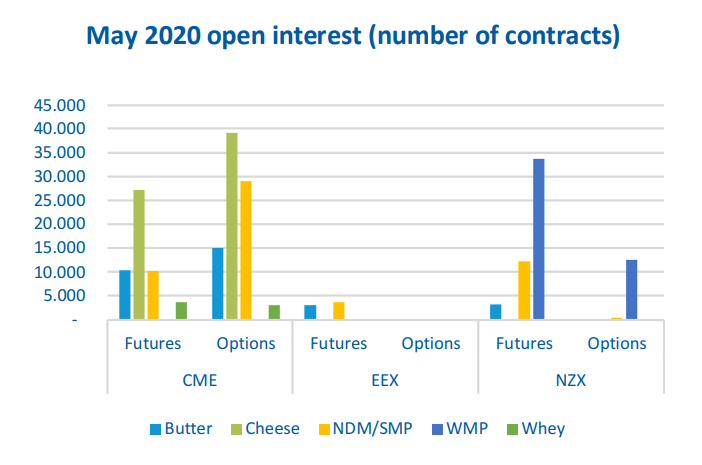
Earlier this year, the Chicago Mercantile Exchange (CME) Group,which has the most widely traded dairy contracts in the world,added Cheddar block contracts to its dairy mix. Because international markets are based on the U.S. dollar, buyers and sellers worldwide can use CME group futures and options for Cheddar blocks to hedge cheese. Trading volume so far has been light—similar to other new contracts during their first year of trading—but volume will likely pick up in 2021. Regardless of light volume, these contracts have already provided market insight,offering the only forward look into global cheese pricing. In time,this could prompt Europe to add a similar contract.
Trading of NZX Milk Contracts Picks Up New Zealand’s Exchange (NZX) added milk contracts (MKP) in 2016 allowing producers and processors to lock in Fonterra’s full season milk price up to five seasons forward. At this point,options contracts make up most of the volume traded. Open interest on the MKP contract increased 58% during the first five months of 2020, indicating remarkable interest. Still, the NZX whole milk powder contract has remained the most popular, with more than 130,000 futures and options traded over the same period.
The European Energy Exchange’s (EEX) dairy and milk futures contracts have had moderate success in recent years, with European butter and skim milk powder (SMP) futures holding most of the volume. Similar to its counterparts, EEX has a European milk futures contract, but open interest on this contract remains at zero because the composite settlement price can be complex for dairy processors, end users, and farmers alike.
As more risk management tools become available and use of these tools grows, the global dairy industry could see more stability in both production and sales over a larger share of milk and dairy products. For instance, in recent years, despite regional price spikes, sales into global markets have continued because an increasing number of buyers and sellers have been employing derivatives.
Dairy producers who use risk management are less affected by market volatility, which means milk production can persist even when prices drop, increasing the time between when prices decline and when producers cut production. During periods of severe price declines, dairy producers who do not manage risk tend to feel the full brunt of market declines. This can cause high cost producers to exit the business. Risk management also requires a certain amount of capital, which can exclude some producers from participating.
With active derivative markets now offered in all of the major milk producing regions, producers have the opportunity to review forecast prices and arbitrage the difference between current and projected prices. Plus, buyers have the ability to forecast future costs from the major dairy supply regions.
World Comment
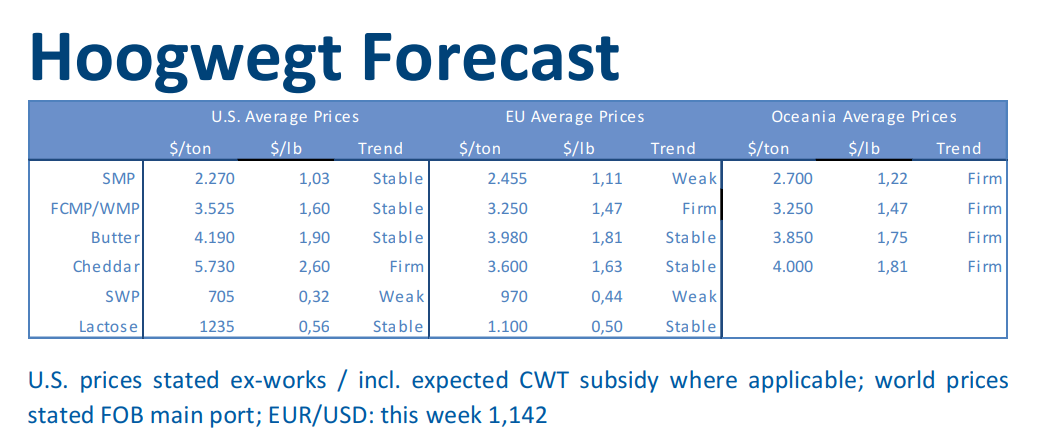
Global supply growth has been disappointing in the months of April and May. Because of the drought in many European countries as well as the impact of Covid19 on the production. Productivity seem to be impacted most in the US, where the changed way of feeding has led to a lower production than forecasted. Whether these co op programs will continue in the future remains unclear for the moment.
Oceania’s forecast for the coming season is good. Weather conditions over the past months and expectations for the coming months are good, setting up New Zealand fora new strong season. Expected growth of 0,25% seems to be modest. But has mainly to do with the strong season last year. Latin America can count as well on good weather conditions for the coming season. This in combination with the expected decrease of local demand due to Covid19 is expected to result in a larger surplus than previous year. Recent rainfall in the EU has diminished the further decrease of production. As a result production growth is not expected to drop below 1%. On the demand side most notably is that China import figures have been strong between June’19 and April’20. Big question here is if this continues for the remainder of 2020.
Wide Array of Tools to Spur Interregional Trading
Growing adoption of risk management tools globally should help keep production more predictable over time, while providing increased market liquidity for buyers and sellers.
Downturns tend to disproportionately impact producers and processors who do not employ risk management, whereas those using derivatives or fixed pricing tend to target a percentage of their annual use or production to provide predictable earnings and are thus less susceptible to price volatility. While these risk managers still represent a small percentage of the total, each year risk management adoption increases. As a result, more sophisticated and market savvy producers and processors will be left to supply global dairy needs over time.
Market corrections could still be significant at times, but risk management can mute the impact on a business’ earnings. While this is not to say that everyone who manages risk can completely avoid the market’s peaks and valleys, those who do are more likely to maintain a minimum level of earnings to sustain their businesses. Looking ahead, trading in options will likely become more popular. Options are contracts that provide the buyer the right, but not the obligation, to buy or sell an underlying commodity, at a specified strike price prior to or on a designated date. Options tend to be less expensive to deploy and can be exercised only when it is to the advantage of the option holder.
As dairy markets become more global in scope, there could also be more adoption of interregional trading. For example, a buyer of specialty cheeses in the United States might want to purchase an EEX futures contract to secure a price that allows for a comfortable margin if European markets are anticipated to increase. With electronic trading, these types of transactions will only become easier to make