USMCA—Much Ado About Nothing

The rebranded, renegotiated North American Free Trade Agreement (NAFTA), now called the United StatesMexicoCanada Agreement (USMCA), was reopened in 2017 and finalized in September 2018, but it has yet to be ratified by the three governments. The U.S. Congress will likely not take up USMCA until sometime this summer, following procedural delays caused by a 35day government shutdown. The International Trade Commission (ITC) has yet to provide Congress with an economic impact report, required prior to a vote. Democrats in Congress argue the deal does not do enough for labor, while Republican legislators maintain it inhibits trade, suggesting significant changes could still be made before Congress votes on the agreement.
Meanwhile, officials from Mexico have warned that they will not ratify the agreement until the United States removes the Section 232 (national emergency) tariffs that President Donald Trump placed on steel and aluminum last July. Both Canada and Mexico responded to those tariffs with retaliatory tariffs, targeting many agricultural products, including U.S. cheese. Since July 2018, U.S. cheese exports to Mexico have slowed considerably. In early March, Mexican officials escalated the situation by threatening to place additional tariffs on more U.S. goods. Canada also remains staunchly opposed to the Section 232 tariffs. U.S. Secretary of Agriculture Sonny Perdue and his counterparts from Canada and Mexico have agreed that removing the Section 232 tariffs and resulting retaliatory tariffs would be a step toward ratification.
U.S. falls short of goals
Renegotiation of NAFTA was an attempt to modernize and address technology issues resulting from the decadesold trade deal implemented prior to the internet. The U.S. dairy industry saw the renegotiations as an opportunity to gain more access to Canada’s dairy market, while preserving current dairy trade with Mexico.
Canada’s dairy industry, however, was determined to preserve its supply management system and market protections, which led to delays and breakdowns in the negotiations. In the end, the United States fell well short of its attempts to gain access to the Canadian dairy market. In fact, the access the United States obtained either already existed in NAFTA or would have been addressed by the TransPacific Partnership (TPP) had the United States remained in the multilateral agreement.
While in the end Canada was forced to make concessions on dairy, it also gained more access to the U.S. dairy market and secured import quotas that will go unused in most years, similar to what’s occurred under the EUCanada Comprehensive Economic Trade Agreement (CETA). While USMCA would require Canada to issue annual import licenses, license holders would not have to actually import dairy products.
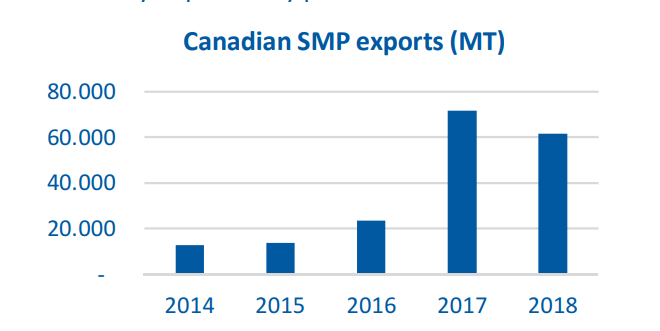
Six months after implementation, USMCA will require Canada to eliminate its Class 6 and 7 milk prices, which now allow the country to sell milk proteins domestically and internationally at belowmarket rates. In exchange, Canada will tie its commodity solids nonfat milk components to the U.S. Class IV price (butterpowder) minus a make allowance. U.S. interests are concerned that Canada will use the value of the Canadian make allowance and how it is derived to circumvent USMCA, undercutting prices in the global market.
In the end, USMCA will be “much ado about nothing.” The deal looks largely like its predecessor and will do little to change trade between the three nations. For the U.S. dairy industry and other ag sectors, the slow path to implementation and fallout from the tariffs appear to be causing more harm than good. While U.S. agriculture would like to see a swift end to the tariffs, Trump is a proponent of tariffs to force negotiation, and some industries— certainly not the dairy industry—argue the tactic has worked.
World Comment
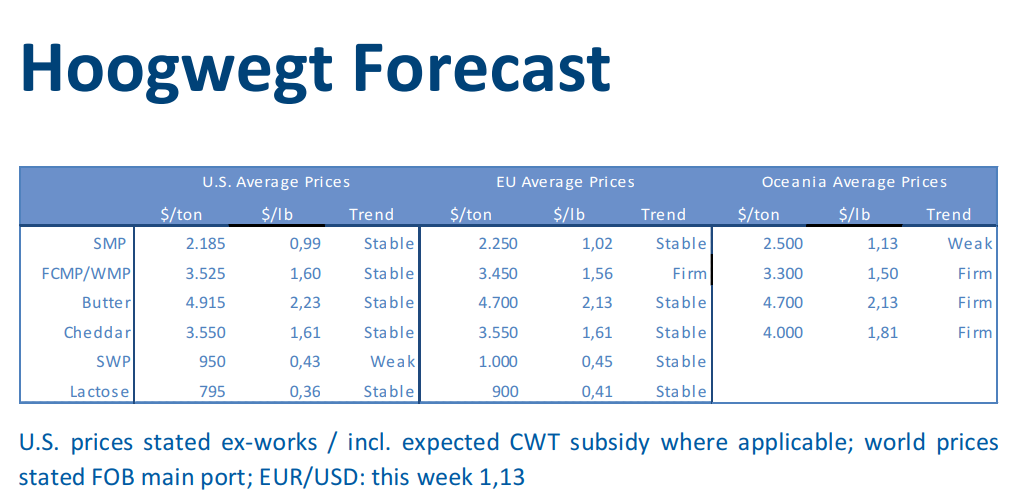
The last few weeks, the SMP market has been remarkably quiet in many regions and prices have been moving sideways. Buyers seem to be expecting lower prices as flush season in Northern Hemisphere is about to start. Both weather and milk prices as well seem favorable for a good milk production. On the bullish side it can be argued that forward coverage for the second quarter of this year seems to be quite a bit less than normal and for sure a lot less than last year. WMP market remains to be very firm with little spot availability in LatinAmerica as well as in Europe and Oceania. Cheese remains the most interesting (soft) commodity to produce as it gives best valorization for the milk; cheese pricing as well fairly stable, similar to the SMP pricing. European butter market has been moving down in the past months, but now becoming competitive on the world market so it is to be seen if prices can go much lower. With global milk production basically unchanged compared to last year; little milk is currently allocated to milk powder. In general, the global demand for dairy products seems to be fairly healthy although there are some concerns about Chinese demand for the coming year as the economic slowdown could negatively impact consumption. Market direction will likely be more clear in the coming month as we will have a more clear picture how the season is starting in Europe and USA. With still a lot of business to be concluded for coming quarters, movement up or down can be significant.
Missed Opportunities Benefit U.S. Competitors
Since NAFTA renegotiations commenced, Canada and Mexico have been entering new trade deals or modernizing existing agreements with New Zealand and the European Union, while the United States has been bogged down renegotiating NAFTA and the KoreaUnited States free trade agreement. During this time, New Zealand and Europe resecured access to Mexico and Canada and gained favorable tariffs and access to Japan, one of the world’s largest dairy markets.
At the same time, the United States has struggled to move forward on bilateral discussions, and by walking away from TPP, the United States missed out on opportunities to reach new trade deals with Japan. The U.S. Dairy Export Council estimates that U.S. competitors could gain $1.3 billion in dairy sales over the next decade if the United States does not soon secure a strong trade deal with Japan. The United States also stands to lose in Mexico. If the United States were to lose export share of skim milk powder in Mexico, or if Mexico were to bolster internal dairy output, the U.S. dairy industry would suffer. Currently, Mexico accounts for approximately 25% of total U.S. dairy exports, making potential losses from this market significant. Moreover, the U.S.China trade dispute, which has negatively affected U.S. dairy exports to China, has added another level of urgency for the United States to move forward on USMCA.
In the end, New Zealand and Europe will likely be the largest beneficiaries of the United States’ new trade policies. In retrospect, USMCA and Section 232 tariffs could prove to be the wedges the European Union and New Zealand needed to gain beneficial access to the worthwhile markets of three of the United States’ closest allies.