HoogWegt: Consumers DriveSustainable Diet Trend
May 2020 HoogWegt report
The term “sustainability” has been used for more than three decades, but as concerns over climate change accelerate and the population of the world surpasses 7.8 billion people, the three pillars of sustainability—profit, people, and planet—have take non a deeper meaning.
Consumers are driving much of the trend toward a sustainable diet, defined as one that can help maintain human health while also ensuring Earth’s resources can be used to feed future generations. While consumers will continue to buy food based on taste, price, convenience, and nutrition, a growing number are also making buying decisions that enhance the health of the planet. The global dairy industry has responded by making significant strides in environmental stewardship.
Moving Toward Organic and Other Trends Several sustainability trends continue to attract consumers, including buying organic, purchasing locally produced foods, and adding plant-based alternatives to the diet. Between 2017 and 2026, the global market for organic dairy foods is expected to increase by an average of 8.9% per year to reach $34.9 billion,according to Organic Dairy Food and Drinks—Global Market Outlook (2017-2026), a report by India based Statistics Market Research Consulting. Consumers who buy organic are often attracted to the industry’s commitment to health and the environment by feeding cows only those feeds grown without using pesticides and not treating cows with antibiotics or rBST.
That said, conventionally produced milk is as safe and nutritious as organic milk, and yields in conventional milk production tend to be higher, often reducing the total number of animals needed to produce the same volume of product.The trend toward buying locally to support communities while reducing transportation costs and thus greenhouse gas (GHG)emissions created by burning fossil fuels is a luxury afforded consumers in food reduction regions of the world. This option often doesn’t exist for consumers who live in food deficit region sand countries that depend on imported dairy products.
Moreover, it is not always more environmentally sustainable to produce food locally. For example, producing milk in arid regions of the world is not as sustainable as producing it in areas where water and feed are plentiful.
Increased consumer interest in plant-based dairy alternatives is complicated. While studies have shown that adding plant-based products to the diet can be beneficial for the planet, production of some dairy based alternatives can actually be worse for the environment. For instance, some palm oil plantations in Asia and elsewhere and new soybean farms in South America have often come at the cost of deforestation, while almond production relies on large volumes of water and regular pesticide use.
Moreover, reducing dairy in the diet does not necessarily result in less GHG emissions because replacing the nutrients and calories of nutrient dense dairy products requires the consumption of lots of other products, including plant based products that also have a carbon footprint, according to the Netherlands nutrient calculation model. The total carbon footprint of the plant-based alternative market is often touted as being smaller than dairy’s total footprint, but that’s only because the world’s dairy industry is more than 30 times larger than the plant-based alternative protein market.
Consumers are also taking note of how their food is produced and packaged. As a result, dairy processors are making efforts to move away from single use packaging and toward zero-waste production, while continuing to conserve energy and other natural resources as well as source supplies locally when possible.
World Comment
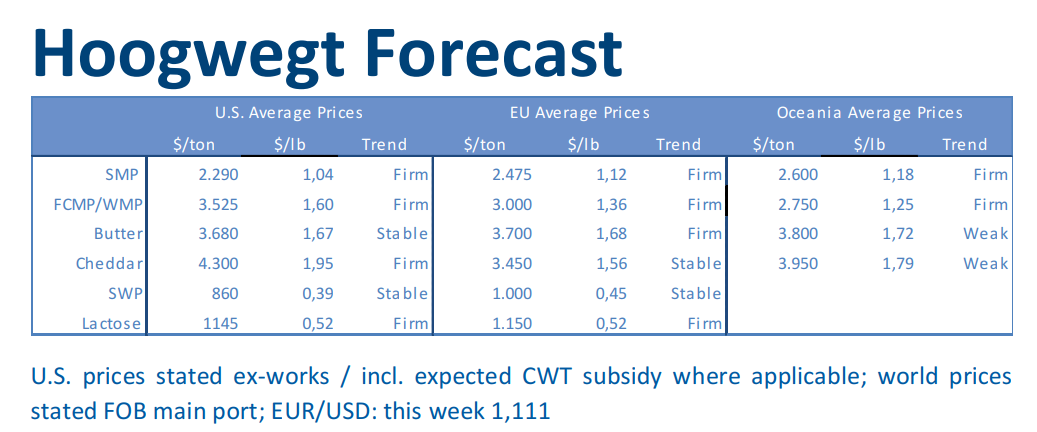
US milk production grew 1,4% yoy in April. However, 11,5% of April’s milk production had to be dumped. As a result US milk production ending up in the market was stable vs last year. Brazilian milk supply is lower than expected, and had to be revised downward from +2% to 1.5%, mainly because of the impact of the Corona crisis on the actual production ending up in the market. The EU didn’t see a significant milk production reduction due to the Corona crisis. Processing plants have been able to manage the new regulations quite well, without influencing the capacity of the plants.However, there has been a lack of rain in the whole of Europe, which does have an impact on the production rates. Growth rates are starting to decline in the UK, France, Germany and the Netherlands. Content levels are not up to standard at the moment, due to the deteriorating quality of the grass. Globally we have seen weaker imports of the top 10 importing countries in January and February, except for the UAE. Remarkable is that China’s Q1 imports are only slightly behind last year’s, despite the already strong import figures in 2019.
Advanced Dairy Regions Most Sustainable
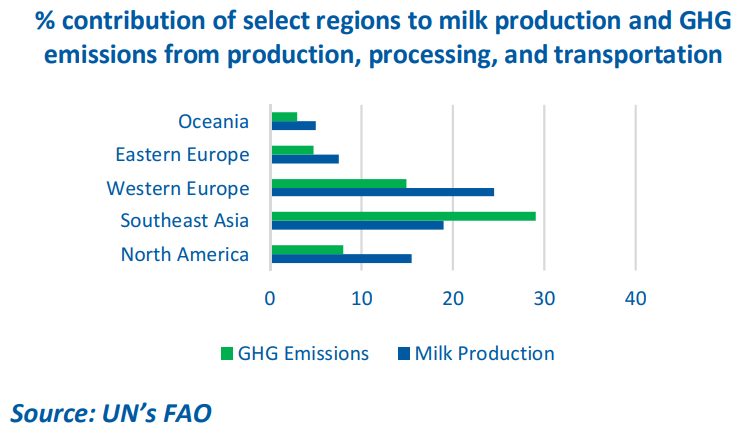
Global production of milk and the meat linked with milk production account for 4% of global GHG emissions, with milk production alone emitting 2.9%, according to the United Nation’s Food and Agriculture Organization (FAO). About 93% of those emissions originate on the farm, and the world’s major dairy regions are the most sustainable, FAO notes. GHG emissions generated on dairy farms in the world’s major production regions of North America, Western Europe, and Oceania account for between 78% and 83% of all dairy emissions in these regions,while dairy farms in less advanced regions are estimated to contribute between 90% and 99% of the sector’s total emissions.
The European Union has embraced several strategies to reduce the industry’s GHG emissions that will also help simplify multilayered polices. Ireland, one of Europe’s fastest growing milk production states, recently committed to reducing GHG emissions from agriculture. Ireland’s pasture-based ruminants excrete between 70% and 95% of their nitrogen intake onto pastures, creating a potent source of GHG, according to Teagasc.
The U.S. dairy industry is also working to improve sustainability.According to a University of Arkansas study, U.S. dairy production accounts for approximately 2% of total U.S. GHG emissions,compared to electricity generation, which accounts for nearly one third of all U.S. emissions. Improvements in milk yields, cow comfort, health and nutrition, and breeding have helped the U.S.dairy industry become more sustainable over time. According to the Innovation Center for U.S. Dairy, producing a gallon of milk today uses 90% less land and 65% less water than in it did in 1944, resulting in a 63% smaller carbon footprint.
New Zealand’s average GHG emissions from dairy farms ranges from a wide 3.1 to 18.8 metric tons per hectare. To reduce their environmental impact, dairy farms in New Zealand are getting larger and relying less on pasture and more on brought in feeds.