African Swine Fever Pushes Protein Prices Higher
HoogWeht Horizon January 2020
The outbreak of African Swine Fever that began in China in August 2018 has since spread to nine other Asian countries. As infected swine herds are culled and removed from the food chain, pork prices have soared and demand for more cost effective proteins, including dairy, has increased.African swine fever, a fatal contagious viral disease that impacts pigs, does not affect people, and thus is not a food-safety concern. However, the highly contagious virus can persist in uncooked meat products for up to 10 months at 4° C. To prevent the disease from spreading, carcasses of infected animals must be destroyed and kept out of the food chain. Currently, there is no vaccine for ASF, but promising research continues. Scientists with USDA’s Agricultural Research Service are close to developing a potentially breakthrough vaccine for ASF that could be fast tracked. But a finished product would likely not hit the market for two years at the earliest.
Spreading through Asia
While ASF is endemic in much of Sub-Saharan Africa, the current outbreak has been confirmed in 10 Asian countries, including Vietnam, the world’s fifth largest pork producer, and most recently Indonesia. ASF has also been confirmed in Russia,Belgium, the Baltic states, and Poland. With the disease now in Indonesia, concern is growing in nearby Australia, a country that along with the United States, Canada, and New Zealand has never had a confirmed case of ASF. So far, the current epidemic has resulted in the culling of an estimated 25% of the world’s pigs,and the herd in China, which once accounted for more than half of the world’s pigs, has been reduced by 40% since January 2018,according to USDA data.As a result, world pork prices have surged. In China, prices have risen 110%, and large Chinese imports of pork have pressured global prices higher. As people worldwide search for more affordable proteins, prices for beef, lamb, and milk proteins have also increased.Since fall 2018, China has substantially increased its purchases of milk powders, which are particularly cost-competitive proteins.
Through November, year-over-year 2019 imports of whole milk powder (WMP) and skim milk powder (SMP) climbed 26.5% and 22%, respectively, according to Global Trade Atlas data. China’s SMP imports from New Zealand during that period rose 8.8%,while Australia’s climbed 31.7%, Germany’s surged 47%, and France’s more than doubled. Meanwhile, China’s SMP imports from the United States fell nearly 88%. At the same time, though,whey imports and prices have languished.
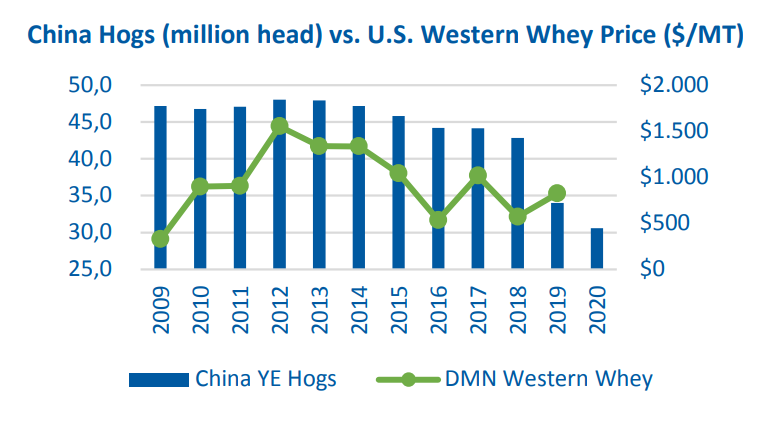
Governments in infected areas have taken aggressive measures to cull afflicted herds and monitor outbreaks, and the Chinese government has started providing incentives for farms and provinces to increase their hog herds.China’s Ministry of Agriculture recently said that it hoped pork production would be at four-fifths of normal levels by the end of 2020. However, independent reports have been a bit less positive and claim rebuilding could take up to five years. Once the spring rainy season arrives, the recent positive trend will likely slow significantly.Going forward, China will continue to rely heavily on Oceania for dairy proteins, which could cause New Zealand and Australia to retreat from other markets. This would open opportunities for EU and U.S. exporters of dairy proteins in other regions of the world—a pattern that has occurred several times in the past.
World Comment
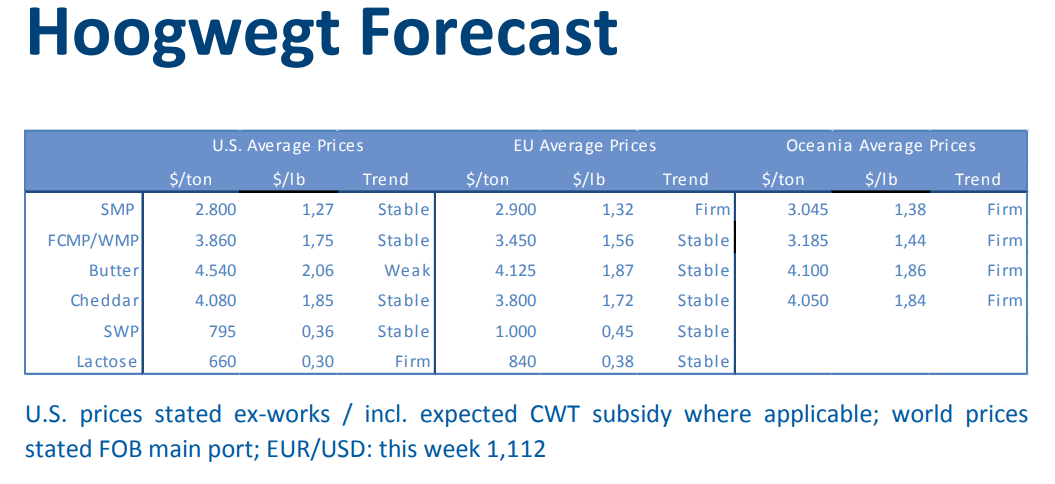
The last few weeks of 2019 and the early start of 2020 were very quiet. The last GDT of 2019 showed a significant price decrease for almost all products and the little business that was concluded was almost all at lower levels than before. However, with everyone coming back to work in this past week, market has almost completely recovered to the levels of early December. Many buyers clearly considered the lower prices of end December as a buying opportunity. Fundamentally market is still the same; there is limited growth in milk production and relatively less milk expected to flow to commodity products.The Islamic world is finalizing purchasing for the Ramadan season and China starts to close down for their New Year in less than two weeks.. Algerian government has announced another tender, surprisingly soon after the previous tender last month, which will support SMP and WMP prices. It will be interesting to see if there is enough demand left in the coming months to push prices above the high we saw early December or that prices will stabilize. Downside potential seems limited for most products.
Whey Prices Could Soar When Pig Herd Rebuilds While the ASF epidemic and other factors have boosted demand for milk powders, a decline in piglet numbers has cut the use of whey and lactose. China’s imports of whey declined by double digits every month in 2019, but the declines started to moderate late in the year, mostly because the basis of comparison started to include year-ago months in which the country was already battling ASF. Despite softer comparisons, China’s year-to-date whey powder imports through November were 20% below the comparable period in 2018, according to Global Trade Atlas data.In 2015 following a similar period when China’s hog sector was devastated by poor demand and rising input costs, China rapidly rebuilt its hog herd, causing whey and lactose prices to surge.Today, the United States remains the largest supplier of whey to China, but EU suppliers have made inroads into that market due to the ongoing U.S.-China trade war. Chinese imports of U.S.whey for the first 10 months of this year were down nearly 43%compared to the same period in 2018. Over the past the past 17 months, Chinese importers have built new relationships with EU exporters. For the January through October period, China’s 2018 year-over-year imports of whey from sources other than the United States increased 19.3% and then rose another 5% in 2019.In a phase-one agreement with the United States, China has agreed to purchase U.S. farm goods, including dairy. China also said it would be lifting tariffs on nearly all dairy products. Tariffs on U.S. whey could drop to 2% as soon as January 2020. If that occurs, U.S. exports of whey to China could rebound quickly,coming at a cost to EU exporters.In December, China waived tariffs on U.S. pork shipments, but the ASF epidemic in China could be stabilizing. If efforts to rebuild the swine herd in China pick up, whey and lactose prices could soar soon thereafter.