
Has Blockchain Technology Arrived?
Hoog Wegt September Article

As food distribution continues to become more global in scope, companies from around the globe are migrating to—or at least thinking about—getting in on blockchain traceability in an effort to pinpoint and contain sources of foodborne illnesses as well as better manage every step of the supply chain. Not only does blockchain technology help companies deal with the legal aspect of tracing an outbreak back to its source, but it also improves a company’s control over its financial, logistics, and qualitycontrol transactions. Blockchain technology is a ledger of continuously updated digital transaction data that provides transparency and efficiency along each step of a supply chain. The advantages of being part of a blockchain system or platform can be numerous for food companies.
Blockchain traceability can dramatically reduce the time it takes to trace the origin of a foodborne illness from days to seconds, allowing those involved to quickly pinpoint, contain, and resolve an outbreak. In addition, the technology can improve margins through minimizing food testing expenses and providing companies with the ability to employ better foodsafety prevention and qualitycontrol methods.
Heightening Brand Credibility
Blockchain traceability can also address consumers’ growing desire to buy local by allowing them to see exactly where their food originated, while at the same time helping companies improve brand credibility through increased transparency. Using a radio frequency identification (RFID) reader, consumers can use a QR code to link to data about a product’s origin, certifications, and road through a supply chain. The technology can also enhance financial transparency. For instance, food companies, including dairy companies, employ letters of credit to guarantee overseas transactions. These bankissued letters of credit protect the interests of both parties, according to the U.S. Department of Commerce.
A bank pays against the draft to the degree the paperwork substantiates delivery, and the customer accepts the product. Blockchain can streamline the document tracking and payment process. At the same time, blockchain technology has its limitations. To work, all parties along the chain—from the producer to the transporter to the manufacturer to the distributor to the retailer—must participate. This has raised concerns that participating companies could use nonparticipation by competitors to their own advantage.
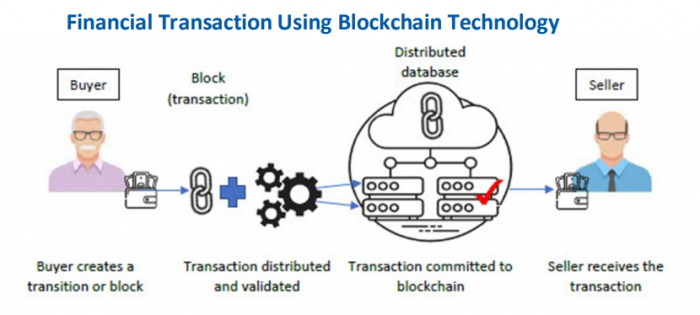
Moreover, participating companies that have missing points along the traceability system or a lack of controls could be labeled highrisk suppliers. These suppliers would then be forced to upgrade their systems or leave the network, while their lowrisk competitors would have a competitive advantage. Financial Transaction Using Blockchain Technology Source: Institute of Food Technologists For blockchain to be effective, the data within a system must also be validated and privacy controls must be implemented due to the risk companies and food producers inherently accept by participating. If these controls are absent, market transparency could be used to exploit pricing dynamics. Furthermore, some fear that animal rights advocates could use detection of a foodsafety issue against supplying farms.
According to Food Safety magazine, large multinational food companies have already been migrating to blockchain traceability, including Carrefour, Unilever, Nestlé, Dole Food, Tyson Foods, and Golden State Foods. As the technology matures, even more companies will migrate to blockchain systems as a way to manage everything from food safety and quality to contracts and logistics. September 20 – 2019
World Comment
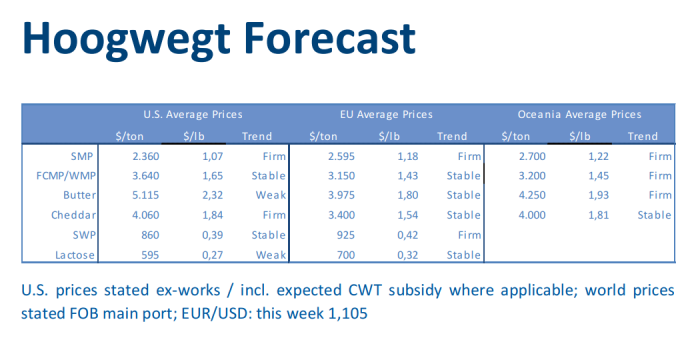
The SMP market is clearly tighter than many had expected and prices made big steps up. There are no surprises on the supply side as all major producing area’s are comfortable with their sales book. Surprise is more on the demand side; Thailand announced extra import quota for 2019 and the Chinese demand continues to be strong.
On top of this the MiddleEast demand is healthy and pipelines are less filled than buyers deem appropriate. Also, rumors are spread for Algeria coming back in the market. All in all, with the little product available for the remainder of 2019 and the strong demand, it seems unlikely SMP prices will soften in the coming months. WMP is more firm than before as well, Asian demand seems sufficient to keep New Zealand manufacturers confident although the peak in the milk production is approaching quickly. SouthAmerica is following the New Zealand WMP prices, but a lot will depend on Algeria as that is their main export market. Butter market remains difficult to read with sentiment in the various regions changing week by week.
However it is unlikely that we will see the USD 6000 levels, that seemed to be the ‘new normal’ the last few years, anytime soon. The whey – complex seems to be at or close to the bottom and buyers seem willing to purchase forward at todays levels. In general the dairy market feels a bit firmer than in the past months, but how much upside is left is to be seen.
Bring it Home Enhancing Company and Consumer Protection
A growing number of companies are recognizing the advantages of blockchain technology but are still unable to participate. For instance, enhanced requirements in the U.S. Food Safety and Modernization Act have created serious documentation challenges for the food logistics sector, yet the scale and availability of blockchain technology and platforms are not advanced enough for widescale adoption. Complicating the issue is that other technologies could be developed and adopted instead.
Thus, companies will likely be slow to invest real dollars until they know which platform will become the standard. That said, with many suppliercustomer relationships requiring access to food safety data and more companies moving to blockchain systems, data on food safety is being combined with financial and legal data throughout the entire supply chain. This singlechain system allows companies to quickly track the origins of a recall and determine liability—a benefit many food companies will see as critical to their success.
Blockchain systems could also be used to hasten trade. For instance, the European Commission’s Trade Control and Expert System (TRACES) is an online, multilingual, management tool with 30,000 users from more than 80 countries that covers sanitary requirements on intraEU trade. By digitizing the certification process, TRACES is simplifying and accelerating trading, according to the European Commission. With countries, regions, multinational retailers, and food processors migrating to blockchain traceability, those who do not adopt the technology could eventually be left out of major trade agreements and supply contracts—if blockchain becomes standard technology in the food industry.